You Can Do the Right Thing for the Wrong Reason
Here's an uncomfortable question that no scorecard will ever ask you: did you show up for someone today because you love them, or because you needed the credit? Did you give generously because it felt right, or because you couldn't stand the image of yourself as someone who didn't? Both versions look identical from the outside. Both would score a "win" on any tracking system. And they are not the same act.
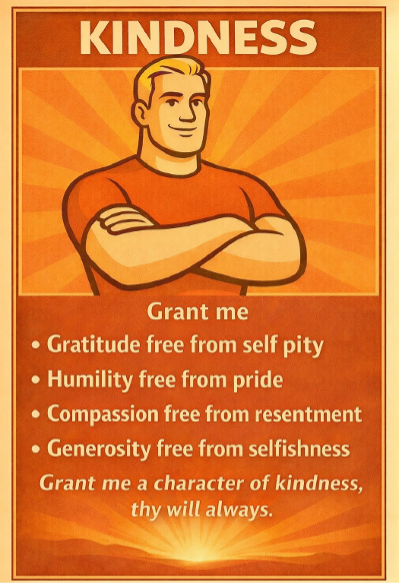
That distinction is the entire subject of a short card I keep close, framed as a prayer rather than a checklist:
Grant me
Gratitude free from self-pity
Humility free from pride
Compassion free from resentment
Generosity free from selfishness
Grant me a character of kindness, thy will always.
Read it once and it sounds like four synonyms for "be nice." Read it twice and you notice it's not asking for four virtues at all. It's asking for four virtues stripped of the exact thing that quietly corrupts each one when nobody's checking.
The system can measure the act. It can't measure the motive.
Everything I've written about building automatic standards assumes the action is the point — pack the bag, make the call, train, keep your word. That's true for most of life. But there's a category of behavior where the action isn't actually the thing that matters; the motive underneath it is. Generosity born from selfishness — giving so people notice you giving — produces the same transaction as generosity born from an open hand, and a completely different person on the other end of years of it. One builds trust. The other, eventually, gets seen through.
This is the blind spot in any purely automated system, including the ones I've spent years building. Automatic Success removes the daily negotiation so a standard gets executed reliably. But reliability of the act says nothing about the condition of the heart doing it. You can hit a "served my family" checkbox every night for a year and still be resentful the whole time — technically consistent, quietly hollow.
Integrity was never just about keeping your word
This is why inteGRITy names character as its own pillar rather than folding it into discipline. Integrity isn't just "did what I said I'd do." It's closer to what this kindness prayer is actually asking for: alignment between the outward act and the inward motive, so the two stop needing to be managed separately. A man who's disciplined but resentful is aligned on one axis and badly misaligned on the other — and the people closest to him usually feel the second one long before they can name it.
The four pairings on that card map almost exactly onto the traps that catch disciplined people specifically, not lazy ones. Gratitude curdling into self-pity — "I'm thankful, but look how much I've had to endure to get here." Humility curdling into pride — "I stay humble, and I want you to notice that I do." Compassion curdling into resentment — showing up for people while quietly keeping score of what it's costing you. These aren't failures of standards. They're standards being kept for the wrong reason, which is a subtler and more dangerous failure because it still looks like success from the outside.
What this asks of you that a tracker can't
You cannot build a Zero-Decision Protocol for a motive. There's no automated bucket for humility free from pride. This one has to be checked the old way — daily, deliberately, out loud if you can manage it — because the moment you stop asking whether the act and the motive still match, they quietly drift apart, and no dashboard will flag it.
So keep the systems. Keep the standards. But add the one question none of them can answer for you: not "did I do it," but "what was actually running underneath when I did." That's the harder audit, and it's the only one that decides whether the man doing all the right things is becoming the man he set out to be.