A Mission Statement Is Just a Standard You Haven't Automated Yet
Most people write a mission statement once, feel good about it for a week, and then let it sit in a drawer while daily life runs on autopilot in a completely different direction. That's not a failure of intention. It's a missing mechanism. A mission statement tells you who you're trying to become. It says nothing about how you're going to act like that person on a random Tuesday when you're tired and nobody's watching.
That gap — between the mission on the wall and the behavior in the room — is exactly where Automatic Success and inteGRITy Series | Automatic Success pick up the thread. Here's the mission statement in question, word for word:
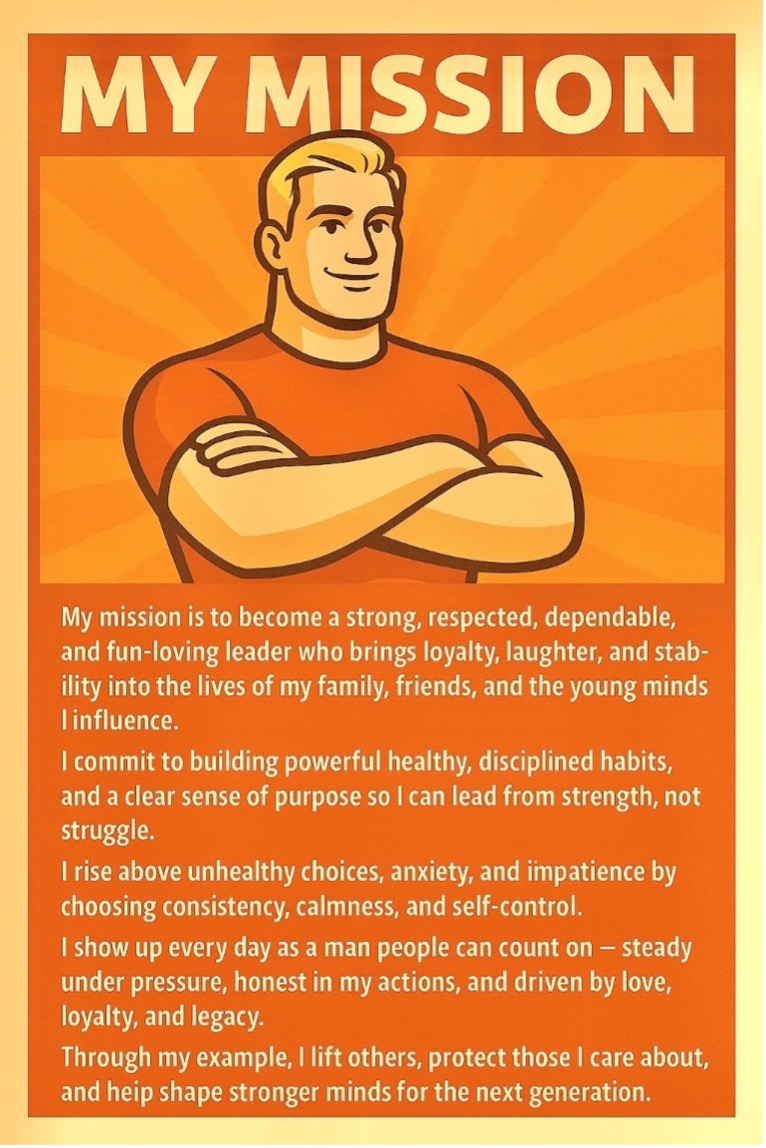
MY MISSION
My mission is to become a strong, respected, dependable, and fun-loving leader who brings loyalty, laughter, and stability into the lives of my family, friends, and the young minds I influence.
I commit to building powerful healthy, disciplined habits, and a clear sense of purpose so I can lead from strength, not struggle.
I rise above unhealthy choices, anxiety, and impatience by choosing consistency, calmness, and self-control.
I show up every day as a man people can count on — steady under pressure, honest in my actions, and driven by love, loyalty, and legacy.
Through my example, I lift others, protect those I care about, and help shape stronger minds for the next generation.
Read it once and it sounds like an identity. Read it again and it's actually a list of specifications waiting for a delivery system.
The mission is the "why." The standards are the "how it actually happens."
Notice what the statement doesn't say. It doesn't say "I hope to be calm." It says "I rise above… anxiety and impatience by choosing consistency, calmness, and self-control." That's not a feeling - it's a decision made in advance, applied repeatedly. It just hasn't been converted into a standard yet.
This is the exact translation Automatic Success is built to perform. A mission gives you the direction. The Zero-Decision Protocol gives you the mechanism that makes the direction real on the days motivation doesn't show up. "Lead from strength, not struggle" isn't something you can will yourself into at 6 PM after a hard day. It's something you build into your mornings, your recovery, your training, ahead of time — so strength is already there when struggle shows up uninvited.
Take the line "steady under pressure, honest in my actions." That's not a personality trait you either have or don't. It's the compounding result of hundreds of small moments where the honest, steady response was made automatic instead of negotiated fresh each time. The mission names the destination. The non-negotiable standard is the road.
This is what inteGRITy actually measures
The four pillars - Health, Wealth, Integrity, Legacy - map onto this mission statement almost line for line, which isn't a coincidence; it's the same underlying architecture. "Strong… disciplined habits" is Health. "Dependable… honest in my actions" is Integrity. "Lift others, protect those I care about, help shape stronger minds for the next generation" is Legacy, stated almost verbatim. The mission is the values layer. inteGRITy's daily journal and scorecard exist to answer one question every night: did today's actions actually move toward that mission, or just sit near it?
That's the real function of a written mission statement inside this framework. It's not a poster for the wall. It's the source document every standard should trace back to. When you build a non-negotiable - wake time, training block, a boundary you hold under pressure - the test isn't "does this feel productive." It's "does this serve the man described on that page." If a standard doesn't trace back to the mission, it's just busyness wearing a schedule.
Put the mission to work
A mission statement earns its place on the wall by getting cross-examined by your calendar. Take one line - "I rise above… anxiety and impatience by choosing consistency, calmness, and self-control" - and ask what non-negotiable standard would make that true on your worst day, not your best one. Build that standard. Track it. Then do the same with the next line.
The mission was never the finish line. It was always the brief. Everything else — the protocol, the pillars, the daily scorecard — is just the crew showing up to build exactly what the brief describes.